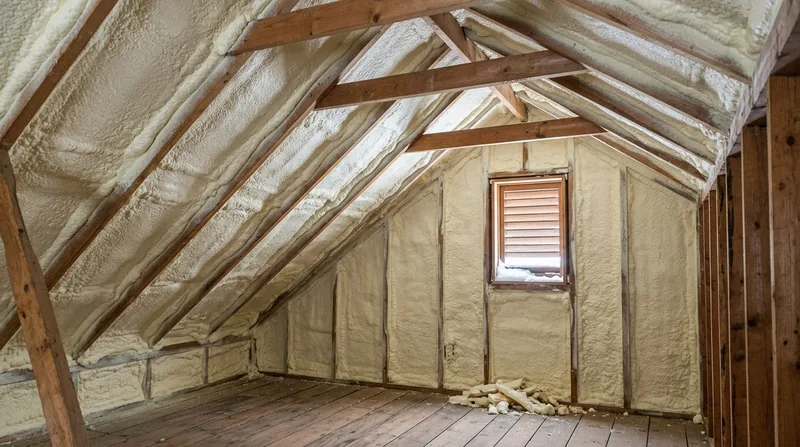




Attic spray foam insulation in Duluth stops the ice dam cycle that builds along the eaves of Hillside and Lakeside homes every winter. When warm air from your living space leaks through the ceiling plane into an uninsulated attic, it melts snow on the roof deck. That meltwater runs down to the cold eaves, refreezes, and builds ice dams that back water under your shingles and into the walls below. We spray closed cell foam directly under the roof deck to create a continuous air barrier and thermal break that keeps the roof surface cold and stops the melt altogether. This is the signature job in zone 7, and it transforms how your home holds heat through the long Minnesota winter.
Why Attic Spray Foam Insulation Matters in Duluth's Steep Hillside Homes
Duluth's older residential stock climbs the steep terrain above Lake Superior, and nearly every house in Lakeside and Hillside carries an attic with plaster walls, older framing, and ceiling penetrations that let heated interior air escape upward all winter long. The lake-effect snow that falls on these roofs is heavy and wet, and the temperature swings between sunny afternoons and sub-zero nights create the perfect conditions for ice dams. Once water backs up under the shingles, it finds its way into the attic framing, the walls below, and eventually the living spaces. A single winter of ice dam damage can cost thousands in water remediation, and the problem repeats every year until the heat loss through the ceiling is stopped.
- Ice dams form when warm attic air melts snow on the roof deck and the meltwater refreezes at the cold eaves.
- Spray foam under the roof deck creates a continuous thermal barrier that keeps the entire roof surface cold.
- The air barrier stops the stack effect that pulls warm, moist indoor air up through top plates and ceiling penetrations.
- Once the ceiling plane is sealed and insulated, ice dams stop forming and water damage ends.
In Duluth, stopping ice dams is the fastest way to protect your home's structural integrity and end the winter water damage cycle.
Key info: Duluth sits in IECC climate zone 7, where long winters and lake-effect snow drive heating costs more than anything else. Homes in Hermantown and Proctor with newer construction still depend on a continuous air barrier to resist the stack effect that pulls warm air up through the attic all season long.
For more on how air sealing works alongside spray foam, see our air sealing service page.
How We Spray Foam Your Attic: Step-by-Step in Duluth
We start with a site visit to measure your attic space, identify all ceiling penetrations (recessed lights, exhaust vents, electrical boxes, plumbing stacks), and assess the condition of any existing insulation. If old fiberglass or cellulose is in place and blocking access or trapping moisture, we remove it first. We then set up mechanical ventilation to manage off-gassing during and after the spray, establish a re-entry window of 24 to 48 hours, and spray closed cell foam at the specified thickness and R-value to meet code and your climate zone.
- We inspect the attic and identify all air leakage points, including rim board vents, soffit gaps, and penetrations around mechanical equipment.
- We remove existing insulation if it is damp, contaminated, or blocking access to the framing.
- We seal all ceiling penetrations with foam before spraying the main roof deck area.
- We spray closed cell foam at the correct ratio and drum temperature, building thickness in controlled passes to avoid over-application and off-gassing.
- We document the final R-value and thickness in writing and provide a re-entry timeline before we leave the site.
The entire process, from inspection to final documentation, ensures that your attic is sealed and insulated to code and to the manufacturer's specifications.
Local example: A Duluth home in Lakeside with a 1,200-square-foot attic and existing blown-in fiberglass typically takes one day for removal and one day for spray foam application, with a 48-hour re-entry window before the attic is safe to walk and the HVAC system can run normally.
For details on how we handle insulation removal before we spray, see our dedicated removal service page.
Attic Spray Foam Methods: Closed Cell vs. Open Cell
| Approach | Description | Best for |
|---|---|---|
| Closed Cell Spray Foam | High-density foam with R-7 per inch, vapor-impermeable barrier, resists moisture and air infiltration at the roof deck. | Duluth attics where ice dams are the problem; sealed roof decks; zone 7 heating-dominant climates. |
| Open Cell Spray Foam | Lower-density foam with R-3.5 per inch, vapor-permeable, allows moisture to dry toward the interior in warm climates. | Attics in milder regions; sound dampening; secondary insulation over existing batts when cost is the priority. |
| Blown-In Cellulose or Fiberglass | Loose-fill insulation; R-3.5 to R-4 per inch; does not seal air leaks or stop ice dams on its own. | Top-up of an existing attic where the ceiling plane is already sealed and ice dams are not a concern. |
| Spray Foam + Blown-In Hybrid | Spray foam under the roof deck for air sealing and thermal break; blown-in over the attic floor for cost-effective bulk R-value. | Large attics in Duluth where ice dams are the priority but total R-value needs to reach R-60 or higher. |
In Duluth, closed cell spray foam under the roof deck is the standard for ice dam prevention and sealed attics. Open cell is rarely the right choice in zone 7 because the heating season is so long and the vapor drive is inward (from cold, dry outside air toward warm interior air), which would push moisture into the foam and the framing.
Attic Spray Foam Insulation Cost in Duluth: What to Expect
Attic spray foam insulation in Duluth typically starts at $1.50 to $2.50 per square foot for closed cell foam under the roof deck, depending on the attic size, the thickness needed to meet code, the condition of existing insulation, and the complexity of the ceiling plane. A 1,200-square-foot attic with existing insulation to remove and a straightforward roof deck layout usually falls in the $2,000 to $4,000 range. Larger attics, multiple roof penetrations, or difficult access can push the cost higher. The best way to know what your job will cost is to request a free written estimate that specifies the R-value, thickness, and square footage in advance.
- Attic size is the primary cost driver: larger attics cost more because they require more material and labor time.
- Existing insulation removal adds cost but is often necessary to see the framing and prevent moisture trapping under the new foam.
- Roof complexity (dormers, skylights, multiple penetrations) increases the time and material needed to seal all air leakage points.
- Accessibility affects labor time: attics with low headroom, tight hatch access, or cluttered spaces take longer to work in.
Every estimate should include the final R-value, thickness in inches, and the square footage being sprayed so you can compare apples to apples across contractors.
For a detailed breakdown of pricing across all our services, visit our full pricing page.
What to Look for When Hiring a Spray Foam Contractor Near Duluth
Not all spray foam work is the same. The difference between a professional installation and a rushed job shows up in the re-entry window, the smell that lingers for weeks, and the R-value you actually receive. Before you hire, ask for a written estimate that includes R-value and thickness, verify that the contractor carries liability insurance and can provide a certificate, check that they plan to use mechanical ventilation during the spray and cure, and confirm the re-entry timeline in advance. Get at least two estimates from local contractors and compare the specifications, not just the price.
- Request a written estimate with R-value, thickness, and square footage, never a price based on a phone call alone.
- Verify that the contractor is fully insured and can provide proof of liability coverage before work begins.
- Ask about the mechanical ventilation plan during spray and cure, and confirm the re-entry window in writing.
- Check references from recent attic jobs in Duluth, Hermantown, or Proctor to confirm quality and reliability.
- Confirm that the contractor will help you understand what permits or building department approvals apply at your address.
- Ask whether the contractor removes old insulation or works around it, and why that choice makes sense for your attic.
The local independent contractor with a local address and a track record in Duluth is your best defense against rig-and-run crews and national franchises that disappear when the smell does not go away.
Ready to get started? Contact us for a free estimate at (218) 241-4881.
Attic Spray Foam Insulation in Duluth: Pricing Guide
| Service | Price | Details |
|---|---|---|
| Attic Spray Foam (Closed Cell) | Starting at $1.50/sq ft | Includes closed cell foam under roof deck, R-7 per inch, air sealing of ceiling penetrations, and written R-value documentation |
| Insulation Removal (Fiberglass or Cellulose) | Starting at $0.50/sq ft | Cost depends on attic size, insulation depth, and whether material is damp or contaminated and requires special handling |
| Hybrid (Spray Foam + Blown-In) | Starting at $2.25/sq ft | Closed cell foam under roof deck for air sealing plus blown-in insulation over attic floor for total R-value and cost efficiency |
| Large or Complex Attic | On estimate | Attics over 2,000 square feet, multiple roof penetrations, or difficult access require on-site measurement before pricing |
| Travel and Service Areas | Included | No separate mileage fee for Duluth, Hermantown, Proctor, Rice Lake, Esko, Scanlon, Carlton, Cloquet, and surrounding areas |
| Free Written Estimate | No charge | Response within 24 hours at (218) 241-4881 with R-value, thickness, and square footage specified in advance |
Indicative pricing, the exact cost depends on square footage, finish, and site access. Free personalized estimate within 24h at (218) 241-4881.


