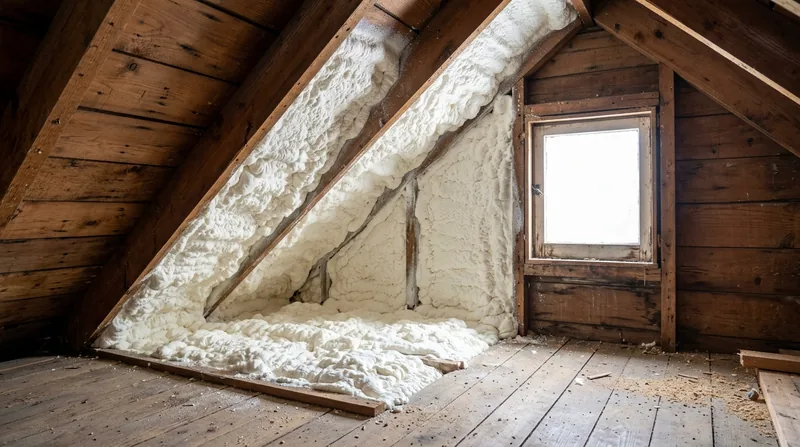




Open cell spray foam insulation in Duluth fills the wall cavities and attic rafter bays of Lakeside and Hillside homes to seal the drafts that drive heating bills all winter long. Duluth sits in IECC climate zone 7 on the shore of Lake Superior, where long winters and the stack effect pull warm, moist indoor air up through top plates, rim joists, and attic penetrations whenever the temperature outside drops below freezing. Early twentieth-century houses climb the steep hillside above the lake with older wall cavities, plaster interiors, and attics prone to ice dams along the eaves whenever heat leaks through the ceiling plane. Open cell foam expands to fill gaps and seal the air barrier that resists that upward pull, and at a lower cost than closed cell, it is the right choice for most Duluth attics and wall cavities where vapor naturally drives outward through the heating season. We have been installing spray foam insulation and air sealing in Greater Duluth since 2012, and we help homeowners and builders understand which foam type solves the problem at hand.
Why Open Cell Spray Foam Insulation Matters in Duluth's Cold Climate
Duluth's heating season runs from October through April, and the stack effect that pulls warm air upward through the building envelope is the single largest source of heat loss in older homes. Open cell foam seals the air gaps that fiberglass batts cannot reach, especially around top plates, electrical penetrations, and the rim joist where the heated interior meets the cold foundation band. In a city built around long snowy winters and short cool summers, energy bills are decided by how well the attic and rim joist hold heat in, not by summer air conditioning. Open cell foam is also the acoustic choice for attic spaces and garages where sound dampening adds value beyond thermal performance.
- Open cell foam expands to fill irregular cavities and gaps that fiberglass batts miss, sealing the air leakage path that drives the stack effect all winter.
- The foam cures to a soft, permeable texture that allows vapor to move through it, which is the correct behavior in Duluth's heating-dominated climate where indoor moisture drives outward.
- Open cell foam costs less per board foot than closed cell, making it the cost-effective choice for topping up sound attics or retrofitting wall cavities in older homes.
- The material absorbs sound, which makes it popular for garage ceilings, bonus rooms, and any attic space where noise reduction is a secondary benefit.
Choosing the right foam type for your Duluth home depends on your building assembly and whether vapor needs to move or be blocked, which is why a site visit and a clear estimate matter before any work begins.
Key info: Duluth's older Lakeside and Hillside homes were built with plaster interiors and uninsulated wall cavities that let warm air escape directly to the exterior. Open cell foam retrofitted into those walls seals the air barrier without trapping moisture, which is the correct physics for a heating-dominated climate where vapor naturally drives outward all winter long.
For more on how spray foam compares to other insulation methods, see our guide to closed cell spray foam insulation in Duluth.
Minnesota building code and the local building department govern thermal barrier requirements and ignition barriers for spray foam in attics and walls. Always verify what applies at your address by contacting the city or county building official, because permitting and registration vary from one city to another across Greater Duluth and there is no reciprocity between jurisdictions.
How We Install Open Cell Spray Foam Insulation in Duluth Attics and Walls
Our process starts with a site inspection to measure the cavity depth, identify air leakage points, and determine the R-value and thickness needed to meet code and your heating goals. We prepare the space by protecting floors and fixtures, set up mechanical ventilation to manage off-gassing during the cure, and spray the foam in multiple thin passes to achieve the target thickness and density. The foam expands to fill gaps around pipes, wires, and framing, and cures to a solid, semi-rigid state that you can drill, cut, or fasten into. We do not spray over wet substrates, active leaks, or contaminated surfaces, because foam cannot fix a moisture problem and will trap it instead.
- We inspect the attic or wall cavity to measure depth, identify air leakage paths, and confirm that the substrate is dry and sound before any foam is sprayed.
- We set up mechanical ventilation during the spray and cure process to manage vapor and odor, and we post a re-entry window of 24 to 48 hours before the space is occupied.
- We spray the foam in controlled passes to achieve the manufacturer ratio and the thickness specified in your written estimate, which includes the R-value and board foot volume.
- We air seal around rim joists, top plates, and penetrations where open cell foam fills the cavity, and we install any required thermal or ignition barriers per code.
Every job is backed by a written estimate that specifies R-value, thickness, and the square footage or board foot volume of foam, so you know exactly what you are paying for and what to expect when the work is done.
Real example: A 1920s home in Duluth's Hillside neighborhood had an uninsulated attic with a vented soffit and a plaster ceiling below. Ice dams formed every winter along the eaves because warm air leaked through the ceiling plane and melted snow that refroze at the cold edge. We sprayed 3.5 inches of open cell foam across the entire attic deck, sealed the soffit vents with rigid blocking and foam, and installed baffles to maintain airflow in any rafter bays that remained vented. The homeowner's heating bill dropped, and ice dams stopped forming that winter.
For related air sealing work beyond spray foam, see our air sealing service page.
Open Cell Spray Foam Methods and Applications in Duluth
| Approach | Description | Best for |
|---|---|---|
| Attic Deck Spray | Spray foam applied directly to the attic floor or rafter bays to create a continuous insulation layer and air barrier. | Older Duluth homes with uninsulated or poorly insulated attics, and sealed roof decks where ventilation is blocked. |
| Wall Cavity Retrofit | Open cell foam injected into existing wall cavities through small drilled holes from the exterior or interior, without removing siding or drywall. | Early twentieth-century Lakeside and Hillside homes with uninsulated plaster walls and existing cavities that cannot be accessed without demolition. |
| Rim and Band Joist Sealing | Open cell foam sprayed into the rim joist cavity where the house frame sits on the foundation, creating an air barrier and thermal break. | Full basement homes across Greater Duluth where cold rim joists draw condensation and allow heat loss and air infiltration. |
| Garage Ceiling and Walls | Open cell foam applied to garage ceilings and walls to reduce heat loss and sound transmission from the garage to living spaces above. | Attached garages in Hermantown, Proctor, and newer Duluth neighborhoods where the garage is conditioned or semi-conditioned. |
| Top-Up or Partial Retrofit | Open cell foam sprayed over existing insulation to fill voids and raise the R-value without full removal of old material. | Attics with sound fiberglass or mineral wool batts that have settled or left gaps, where full removal is not cost-justified. |
Each approach is chosen based on your building assembly, the failure mode you are trying to fix, and whether the cost of a full retrofit is justified by the heat loss you are seeing. A site visit and a written estimate help us recommend the right method for your home.
Open Cell Spray Foam Insulation Cost in Duluth: What to Expect
Open cell spray foam in Duluth typically costs starting at $0.55 per board foot, with most residential attic and wall jobs ranging from $0.55 to $0.85 per board foot depending on cavity depth, accessibility, and the thickness required to meet your R-value target. A standard 1,200-square-foot attic topped with 3.5 inches of open cell foam might cost between $2,000 and $3,500, while a wall cavity retrofit in an older home typically runs $1,500 to $3,000 depending on the number of cavities and the ease of access. Rim joist sealing in a full basement is usually a smaller job, from $800 to $1,500 per run. The final cost depends on how many board feet of foam you need, which is determined by the cavity size, the thickness required for your R-value, and the square footage of the space.
Factors that affect the cost include the depth and width of the cavities you are filling, the R-value you are targeting (which determines thickness), whether the substrate is clean and dry, and how easy it is for our crew to access the space. Older homes in Duluth often have irregular framing and small attic access doors that slow down the work, and that shows up in the estimate. A job that requires removal of old insulation, repair of roof leaks, or treatment of contaminated substrate costs more than a clean top-up of a sound attic.
We always provide a written estimate with the R-value, thickness, and board foot volume specified, so you know exactly what you are paying for. Getting 2 or 3 estimates from different contractors is smart, because it helps you compare scope, materials, and labor across proposals. Be wary of any estimate that does not include R-value and thickness, because that is the sign of a contractor who is not measuring the job carefully.
For a detailed breakdown of pricing across all our services, see our full pricing page.
What to Look for When Hiring an Open Cell Spray Foam Insulation Contractor Near Duluth
Hiring the right spray foam contractor is the difference between a job that solves your heating problem and one that creates new problems. The spray foam trade has two types of operators: local independent shops with a local address and local relationships, and rig-and-run crews from out of state that spray a job in an afternoon and are gone before the smell fades. We are positioned as a local independent, and the way to verify any contractor is to check their insurance, ask for references from recent jobs in your neighborhood, and get a detailed written estimate that includes R-value and thickness.
- Verify that the contractor is fully insured and ask to see a certificate of insurance that covers general liability and property damage, because spray foam work carries real risk if something goes wrong.
- Ask for references from homeowners in Duluth, Hermantown, Proctor, or Cloquet who had work done in the past 12 months, and call at least two of them to ask about the experience and whether any issues came up after the job.
- Get a written estimate that specifies the R-value, thickness in inches, and the total board feet of foam, so you can compare apples to apples across multiple contractors.
- Understand what permits apply at your address by contacting your local building department, because thermal barrier and ignition barrier requirements vary from city to city across Greater Duluth.
- Ask whether the contractor will fix moisture problems before spraying, because foam cannot solve a wet substrate, and any contractor who promises to spray over an active leak or standing water is cutting corners.
If you are working with an HOA or a historic district, check whether exterior work or changes to the roof line require architectural approval, because that can add time to the permitting process. Always verify the contractor's insurance and references before signing anything, and do not hesitate to ask hard questions about their experience with your type of home.
Ready to get started? Contact us for a free estimate, or call (218) 241-4881 to discuss your project and get a site visit scheduled.
Open Cell Spray Foam Insulation in Duluth: Pricing Guide
| Service | Price | Details |
|---|---|---|
| Open Cell Spray Foam, Attic Top-Up | Starting at $0.55/board ft | Foam applied over existing insulation to fill voids and raise R-value; cost depends on cavity depth and thickness needed |
| Open Cell Spray Foam, Wall Cavity Retrofit | Starting at $0.60/board ft | Injection foam into existing walls without demolition; price reflects access difficulty and number of cavities to be filled |
| Open Cell Spray Foam, Rim and Band Joist | Starting at $800 per run | Sealing the foundation band where basement meets house frame; cost depends on linear feet and whether full or partial coverage |
| Open Cell Spray Foam, Garage Ceiling or Walls | Starting at $0.65/board ft | Sound dampening and thermal break for attached garages; final cost depends on square footage and cavity depth |
| Travel and Site Inspection | Included | No separate mileage or call-out fee within Duluth and surrounding service areas; estimate response within 24 hours |
| Free Written Estimate | No obligation | Includes R-value, thickness, and board foot volume; call (218) 241-4881 to schedule your site visit today |
Indicative pricing, the exact cost depends on square footage, finish, and site access. Free personalized estimate within 24h at (218) 241-4881.


