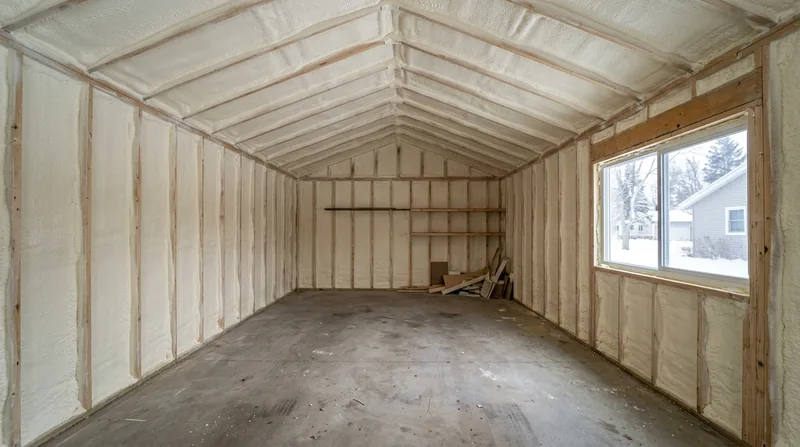




Garage spray foam insulation in Duluth transforms an uninsulated detached or attached garage from a heat sink into a usable workshop and vehicle storage space through the long snowy winters that dominate St. Louis County. Garages without insulation stay 20 to 30 degrees colder than the heated house, pulling warm air through shared walls and rim joists while driving up whole-home heating costs. We spray closed cell or open cell foam directly onto the interior walls and ceiling framing, sealing air leaks and building an R-value barrier that holds heat and stops the stack effect that pulls warm, moist indoor air upward through top plates and into the attic. The result is a garage that stays warm enough for tool work, vehicle storage, and comfort, without the energy penalty of an uninsulated shell. Duluth homeowners and contractors across Hermantown, Proctor, and Rice Lake have relied on our spray foam work since 2012 to insulate garages and prepare them for year-round use.
Why Garage Insulation Matters in Duluth's Long Winter Climate
Duluth sits at the base of Lake Superior in IECC climate zone 7, where heating costs are driven by how well your home holds heat through eight months of cold, snow, and wind. An uninsulated garage connected to or adjacent to the main house becomes a thermal liability. Warm air leaks out through the shared wall or rim joist, cold air infiltrates through overhead doors and gaps around framing, and the temperature differential forces your furnace to work harder to maintain indoor comfort. Spray foam stops that leakage at the source by creating a continuous air barrier and thermal break across walls, ceilings, and the rim joist band that sits directly above the foundation.
- We seal air leaks around door frames, window openings, and rim joist bands that let cold air infiltrate and warm air escape.
- We apply closed cell or open cell foam to the interior ceiling to stop heat loss through the roof plane and prevent ice dam formation along the eaves.
- We insulate the shared wall between garage and house to reduce heating load and maintain temperature consistency across the home.
- We create a vapor barrier on the interior side of the spray foam to manage the moisture that drives inward from Lake Superior air during winter heating season.
A well-insulated garage in Duluth is a direct cost reduction and a year-round usable space, not a seasonal storage shed.
Local example: A detached two-car garage in Duluth's Hillside neighborhood, built in the 1970s with plywood walls and an unvented attic, loses enough heat through the ceiling and rim joist that the owner runs a space heater in winter. Spray foam on the ceiling (4 to 6 inches closed cell) and the rim band above the foundation stops that loss, makes the space usable for woodworking, and cuts the heating bill by holding the house envelope tight.
For more on how spray foam seals and insulates, see our page on air sealing in Duluth.
How We Insulate Garages in Duluth: Process and Methods
Garage insulation starts with a site visit to measure the ceiling height, wall area, and any existing insulation or obstructions. We assess the framing condition, identify air leaks around overhead doors and rim joists, and determine whether closed cell foam (higher R-value, vapor barrier, condensation control) or open cell foam (lower cost, sound dampening, vapor-open) is the right fit for your use. We prepare the space, protect concrete floors and any stored items, and apply foam in controlled passes to achieve the specified R-value and thickness without overshooting or leaving voids.
- We remove any loose or deteriorated insulation and air-seal the rim joist band before applying new foam.
- We spray the ceiling first, working in overlapping passes to build thickness evenly and achieve the target R-value per manufacturer spec.
- We foam the walls from bottom to top, paying special attention to corners, door frames, and the shared wall between garage and house.
- We ventilate the space with mechanical fans during and after application, and we communicate a 24 to 48 hour re-entry window before the foam fully cures.
- We inspect the finished surface for coverage, thickness, and any missed spots, and we provide a written estimate with R-value and thickness specifications.
The entire process takes one to two days depending on garage size and the extent of existing insulation removal.
Example in Proctor: A homeowner with a 20-by-24-foot attached garage in Proctor, built in the 1980s with fiberglass batts that have settled and compressed, calls for a top-up. We find the existing R-19 has degraded to R-12 effective value due to settling and air gaps. Rather than tear out and replace, we spray 3 inches of open cell foam over the existing batts on the ceiling and 2 inches on the shared wall, bringing the assembly to R-30 equivalent and sealing all air leaks. Cost is lower than full removal and re-insulation, and the garage is warm and usable by the next day.
Learn more about our closed cell spray foam options for maximum performance in Duluth's climate.
| Approach | Description | Best for |
|---|---|---|
| Closed Cell Foam, 4-6 inches | High-density foam with built-in vapor barrier, R-6 per inch, stops air and moisture infiltration, controls condensation on metal framing. | Garages with metal studs, high moisture risk, or where maximum R-value in minimal thickness is required. |
| Open Cell Foam, 5-8 inches | Lower-density foam, R-3.5 per inch, vapor-open, provides sound dampening and cost savings, requires a separate interior vapor barrier in cold climates. | Budget-conscious garages, workshop spaces where sound control matters, and retrofit jobs over existing insulation. |
| Spray Over Existing Fiberglass Batts | Apply 2-4 inches of foam directly over settled or degraded batts to seal gaps and add R-value without full removal. | Older garages with existing insulation, cost-sensitive projects, and spaces where removal debris is a concern. |
| Full Removal and Replacement | Strip existing insulation, clean framing, and spray new foam from bare wood for maximum performance and air sealing. | Garages with contaminated, damaged, or ineffective insulation, and new construction or major renovation. |
Garage Spray Foam Insulation Cost in Duluth: What to Expect
Garage insulation pricing in Duluth starts at $1,200 for a small single-car garage with open cell foam on the ceiling, and scales upward based on garage size, foam type, and whether you need existing insulation removed. A typical two-car attached garage with 500 to 600 square feet of ceiling and wall area runs $2,500 to $4,000 installed, depending on whether you choose open cell or closed cell foam and the depth of existing insulation. A detached garage with full wall and ceiling coverage, rim joist insulation, and closed cell foam for maximum performance can run $4,500 to $6,500. The main cost drivers are ceiling area, wall area, foam density and R-value target, and the scope of air sealing around doors and rim joists.
We provide a written estimate with R-value and thickness specifications at no charge, and that estimate is binding unless you request a scope change. We recommend getting 2 to 3 estimates from local contractors to verify pricing and scope, and always verify that each estimate includes specific R-value targets and application thickness. Avoid estimates with no R-value spec, no thickness detail, or a price far below market, as these often signal rushed work, inadequate equipment, or insurance that cannot be verified. See our full pricing overview for a detailed breakdown and examples.
Call us at (218) 241-4881 for a free estimate or visit our contact page to request one by email.
Garage Spray Foam Insulation Near Me: What to Look for When Hiring a Local Contractor
Spray foam insulation is a high-skill trade, and the difference between a careful, insured local contractor and a rig-and-run crew is the difference between a warm, dry garage and a space with lingering chemical smell, poor adhesion, and no one to call when something goes wrong. When you are evaluating contractors in Duluth, Hermantown, Cloquet, or any of the surrounding towns, ask for specific credentials and verification before signing a contract.
- Verify that the contractor carries full insurance and can provide a certificate of insurance naming your address as an additional insured before work begins.
- Request a written estimate that specifies R-value, foam thickness in inches, and the closed cell or open cell product being used, not just a square-foot price.
- Ask whether the contractor will ventilate the space during application and provide a re-entry window, and confirm that mechanical ventilation is part of the scope.
- Check references from recent jobs in your neighborhood and ask those homeowners about smell, cleanup, and follow-up support after the cure period.
- Confirm that your local building department does not require a permit for garage insulation at your address, and if one is required, verify that the contractor will help you navigate the application process.
A contractor who can answer these questions clearly and provide documentation is the one to hire. Contact us at (218) 241-4881 or through our contact page to discuss your garage and get a no-obligation estimate.
Garage Spray Foam Insulation in Duluth: Pricing Guide
| Service | Price | Details |
|---|---|---|
| Single-car garage, open cell ceiling | Starting at $1,200 | Ceiling insulation only, 4 to 6 inches open cell foam, includes air sealing around overhead door frame |
| Two-car attached garage, mixed foam | Starting at $2,500 | Ceiling and shared wall with house, open cell foam, 500 to 600 square feet coverage, full air sealing |
| Two-car garage, closed cell full coverage | Starting at $4,000 | Walls, ceiling, and rim joist, closed cell foam for vapor control and condensation resistance, 600 to 800 square feet |
| Existing insulation removal and replacement | On estimate | Cost depends on insulation type, volume, and disposal, plus new foam application. Site visit required to assess condition |
| Travel and site visit | Included | No mileage fee or travel charge within Duluth and surrounding service areas in St. Louis, Carlton, and Pine counties |
| Free written estimate | No obligation | Response within 24 hours at (218) 241-4881, includes R-value and thickness specifications, no deposit required |
Indicative pricing, the exact cost depends on square footage, finish, and site access. Free personalized estimate within 24h at (218) 241-4881.


