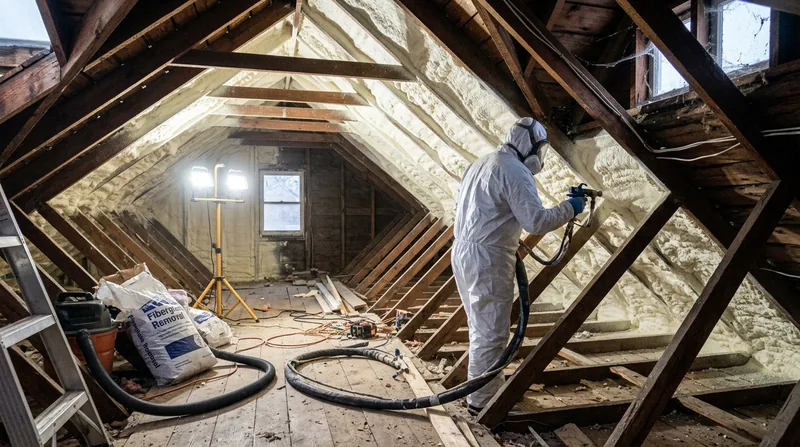




Homes across the hillsides of Duluth, Hermantown, and Carlton often face a hard choice: outdated insulation that no longer holds heat, or a full tear-out and replacement. Insulation replacement and re-insulation in Duluth is not a cosmetic upgrade. It is the difference between a $300 monthly heating bill and a $500 one, month after month through a zone 7 winter where lake-effect snow and sustained cold drive energy demand harder than almost anywhere else in the Upper Midwest. Early twentieth-century homes built into the steep hillside above Lake Superior carry plaster walls and attics that have settled and shifted; newer construction toward Proctor and Esko brings tighter framing but still depends on a continuous air barrier to resist the stack effect that pulls warm indoor air upward all season long. When fiberglass batts compress, when blown-in settles and leaves gaps, or when old spray foam fails, the only answer is removal and replacement with material sized for Duluth's climate. We remove failed insulation and install new spray foam paired to your attic, rim joist, or wall cavity, with R-values and thicknesses specified in writing and built for the winters you actually experience.
Why Insulation Replacement Matters in Duluth's Lake-Effect Winter Climate
Duluth's position on the shore of Lake Superior creates a climate that punishes poor insulation. Cold air masses collide with lake water, generating sustained snow and wind that drive heating demand for nearly eight months of the year. A home with failed or settled insulation loses heat through the attic and rim joist faster than a new furnace can replace it, and the stack effect pulls warm, moist indoor air upward through gaps in the ceiling plane and into rim joists, where it meets cold band joists and condenses. This cycle repeats every winter, degrading whatever insulation remains and creating ice dams that back water under shingles.
- Failed fiberglass batts and settled blown-in insulation leave air pockets that conduct heat directly outdoors.
- Spray foam replacement seals the rim joist and attic floor to resist the stack effect and stop warm air leakage at the source.
- Written specifications for R-value and thickness ensure the insulation is sized for zone 7 winters, not a generic national standard.
- Removal of old insulation prevents compression and settling that would defeat new material before the first season.
The cost of leaving failed insulation in place compounds every month the heating season runs.
Local example: A 1970s ranch home in Duluth with original fiberglass batts in the attic and no rim joist insulation can lose 25 to 35 percent of its heat through the ceiling and band joist. Replacement with closed cell foam on the rim joist and open cell in the attic typically cuts that loss in half, paying for itself in heating bills within five to seven years.
For guidance on permits and code compliance in your city, consult the City of Duluth Building and Zoning Division, which enforces the Minnesota Energy Code and building code for your address.
How Insulation Removal and Replacement Works in Duluth Homes
Replacement begins with honest assessment. We inspect the existing insulation, measure depth and coverage, check for moisture or contamination, and determine whether the substrate (attic deck, rim joist, wall cavity) is sound enough to receive new foam. If the attic deck or rim joist is wet, rotted, or contaminated, we address that first or walk away from the job. If the cavity is sound, we remove old material to the sheathing, vacuum and seal the space, and then spray new foam to the thickness and R-value specified in your estimate. The process takes one to three days depending on square footage and complexity, and we help you navigate what permits apply at your address.
- We inspect the existing insulation and substrate before quoting to confirm the job is sound.
- We remove all old fiberglass, blown-in cellulose, or failed foam down to the deck or framing.
- We seal air leaks around rim joists, top plates, ductwork, and penetrations before foam application.
- We spray new foam to the thickness and R-value specified in your written estimate.
- We provide mechanical ventilation during cure and a forty-eight-hour re-entry window before the space is occupied.
Proper removal and replacement restores the thermal envelope without shortcuts or surprises.
Duluth example: A 1,200-square-foot attic in Cloquet with settled blown-in insulation and rim joists exposed to basement temperature requires removal, air sealing of the top plate, and approximately 5 to 6 inches of open cell foam on the attic floor, plus 2 inches of closed cell on the rim joist. The job typically runs four to six days from estimate to completion, and your heating bills drop measurably the first winter.
See our full insulation removal service page for details on safe extraction and disposal of old material.
Replacement Methods and Foam Types for Duluth Attics and Rim Joists
| Approach | Description | Best for |
|---|---|---|
| Open Cell Spray Foam Attic Replacement | Low-density foam sprayed 5 to 7 inches thick on the attic floor, seals air leaks, allows the attic to breathe, and costs less than closed cell. | Attics with vented roof decks or where vapor permeability is acceptable. Most cost-effective attic retrofit in zone 7. |
| Closed Cell Spray Foam Rim Joist and Band Replacement | High-density foam applied 2 to 3 inches thick on rim and band joists, provides vapor barrier, resists moisture, and delivers R-6 per inch. | Cold rim joists in basements where warm house air meets band joist. Essential for Duluth and Carlton homes with condensation history. |
| Hybrid Attic and Rim Retrofit | Open cell foam on attic floor combined with closed cell on rim and band joists, addresses both heat loss and moisture control. | Complete home replacement where attic and basement insulation are both failed. Balanced cost and performance for zone 7 climates. |
| Injection Foam Wall Cavity Replacement | Low-pressure injection foam applied into closed wall cavities without demolition, fills gaps and compacted fiberglass in place. | Pre-1980 homes in Lakeside and Hillside with plaster and lath walls where cavity insulation has shifted or settled. |
Each method is chosen based on your home's age, existing cavity depth, moisture history, and the specific failure mode. We specify R-value and thickness in writing before any foam touches your home.
Insulation Replacement and Re-Insulation Cost in Duluth: What to Expect
Spray foam insulation replacement is priced by the board foot (the volume of foam measured on site), not by the square foot. Cost depends on several real factors: the depth of the cavity (attic floor versus rim joist versus wall cavity), the type of foam (open cell or closed cell), the existing substrate condition, access to the space, and whether old insulation must be removed first. A straightforward attic replacement in a 1,200-square-foot home typically starts at $2,800 to $3,500; a full hybrid retrofit including rim joists and attic can run $5,000 to $8,000 or more. These figures assume sound substrate, accessible cavities, and no major air-sealing complications. Homes with wet basements, contaminated attics, or difficult access cost more because the work itself is more involved.
The single most important step is getting a written estimate that specifies R-value, foam thickness, coverage area, and board footage. Never accept a quote without these details, and never trust a price that sounds too low. We help you compare estimates fairly by explaining exactly what each one covers.
See our full pricing page for ranges and the factors that move cost up or down, and call (218) 241-4881 for a free written estimate at your address.
What to Look for When Hiring a Spray Foam Insulation Contractor Near Duluth
Not all spray foam contractors work the same way, and the difference shows up months or years after the job is done. A good contractor provides a written estimate with R-value and thickness, offers multiple references, explains permits and code requirements, and maintains insurance you can verify. A bad contractor quotes by the square foot with no R-value specified, promises immediate re-entry into the space, sprays without mechanical ventilation, and disappears if the smell or off-gassing lingers. Before you hire anyone, including us, ask for proof of insurance, check that their estimate matches the code in your city, and call at least two other shops for comparison.
- Request a written estimate that lists R-value, foam thickness in inches, total board footage, and the specific foam type (open or closed cell).
- Ask whether the contractor carries full insurance and ask to see a current certificate of insurance naming your address.
- Confirm what permits apply at your address by calling your city building department, and verify the contractor knows what that means.
- Get at least two other estimates from independent local contractors so you can compare scope and price fairly.
- Check references from jobs in your neighborhood, and ask those homeowners about the contractor's responsiveness and cleanup.
The lowest price is rarely the best value, and the fastest job is almost never done right.
Call us at (218) 241-4881 for a free estimate and we will walk you through what applies at your address and what your home actually needs.
Insulation Replacement & Re-Insulation in Duluth: Pricing Guide
| Service | Price | Details |
|---|---|---|
| Attic Replacement, Open Cell Foam | Starting at $2,800 | Covers removal of old insulation, air sealing, and 5 to 7 inches of open cell foam on attic floor for typical 1,200 sq ft home |
| Rim Joist and Band Joist Replacement, Closed Cell Foam | Starting at $1,500 | Removal, air sealing, and 2 to 3 inches of closed cell foam on rim and band joists, includes basement perimeter |
| Hybrid Attic and Rim Retrofit | Starting at $5,000 | Complete replacement of attic insulation plus rim joist sealing with both foam types, typical for homes with both failures |
| Injection Foam Wall Cavity Retrofit | Starting at $3,200 | Injection into closed wall cavities without demolition, cost varies by wall area and cavity accessibility in older homes |
| Complex or Large-Scale Replacement | On estimate | Wet basements, contaminated attics, or multiple zones require on-site inspection before a firm price is given |
| Free Written Estimate | No cost | Response within 24 hours at (218) 241-4881, includes R-value and thickness specifications, no obligation to book |
Indicative pricing, the exact cost depends on square footage, finish, and site access. Free personalized estimate within 24h at (218) 241-4881.


