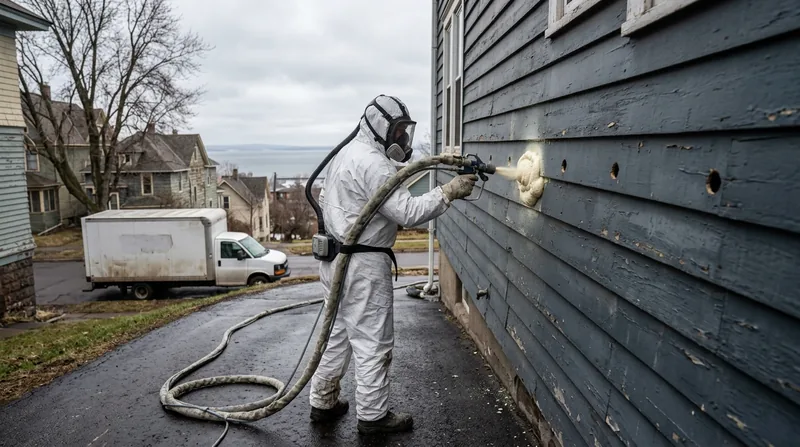




Duluth's early twentieth-century homes climbing the Hillside above Lake Superior often have wall and injection foam insulation challenges that standard renovation cannot solve. Plaster walls, tight spaces between studs, and the impossibility of opening walls without destroying historic interiors make injection foam the practical answer for homeowners in Lakeside, Hillside, and the neighborhoods around Rice Lake and Esko. The long winters and stack effect that pulls warm indoor air upward through wall cavities demand continuous insulation without demolition. Wall injection foam fills closed cavities in minutes, seals air leaks that fiberglass misses, and holds heat in place when Lake Superior's wind presses against your exterior. We have been solving this problem since 2012 for Duluth homeowners who refuse to tear out plaster.
Why Wall and Injection Foam Matters in Duluth's Historic Homes
Duluth's residential stock was built around long winters and the stack effect that dominates heating losses. Early twentieth-century construction in Lakeside and Hillside relied on plaster, lath, and cavity walls that were never insulated. Modern building science now knows that air sealing and continuous insulation are the only defenses against the pressure that forces warm, moist indoor air upward through top plates, rim joists, and wall cavities all winter long. Injection foam stops that air movement without opening the walls, without disturbing the plaster, and without the weeks of demolition and patching that would otherwise be required.
- Injection foam fills wall cavities from the outside without opening interior plaster or drywall.
- The process seals air leaks that fiberglass batts cannot reach, reducing the stack effect that drives heating costs.
- Duluth's lake-effect winters and high heating bills reward every point of R-value gained in walls and cavities.
- Historic homes in Duluth and Hermantown preserve their appearance and character while gaining modern thermal performance.
- Injection foam cures quickly and requires no interior access, making it practical for occupied homes.
For homeowners in Duluth's Hillside neighborhood where plaster is the rule and tearing out walls is not an option, injection foam is often the only realistic path to real insulation gains.
Key info: Minnesota building code requires that any spray foam installation include a thermal barrier (drywall, plaster, or equivalent) to meet the fifteen-minute ignition barrier standard. This distinction is often misunderstood by generalists, so verify that your contractor names it correctly and understands the code that applies at your address. The building official in your city, not the insulation contractor, makes the final call on what the code requires.
Learn more about how closed cell spray foam insulation delivers the density and R-value needed for wall cavities and sealed assemblies.
How Wall Injection Foam Works in Duluth Homes
Injection foam is a field process that requires access to the exterior wall, small entry holes drilled at strategic points, and a pump rig that forces low-pressure polyurethane foam into the closed cavity. The foam expands to fill the space, adheres to the studs and sheathing, and cures into a solid, continuous insulation layer that seals air leaks and resists the moisture vapor drive that dominates Duluth's heating season. The exterior is then sealed, holes patched, and the interior remains undisturbed. The entire process takes hours, not days, and re-entry is safe within twenty-four to forty-eight hours after cure.
- We drill small access holes in the exterior wall at points determined by cavity layout and stud spacing.
- A low-pressure injection rig pumps foam into the cavity, filling voids and sealing air leaks as it expands.
- The foam cures to a rigid, closed-cell structure that resists moisture vapor and maintains its R-value for decades.
- We patch the exterior holes and ensure the thermal barrier (existing plaster or drywall) remains intact on the interior.
- Mechanical ventilation is run during cure to manage any off-gassing, and the home is safe for occupancy within one to two days.
The result is continuous insulation and air sealing throughout the wall cavity, something fiberglass batts cannot deliver.
Example: A 1920s home in Duluth's Hillside neighborhood has plaster walls over brick and wood framing. The homeowner wants to add insulation but cannot disturb the interior plaster. We access the wall from the exterior, drill holes at each stud cavity, and inject closed-cell foam that fills the void and seals the air leaks. The exterior is patched, the plaster stays intact, and the wall now has an R-value of 14 to 18, compared to nearly zero before. Heating bills drop noticeably in the first winter.
For related services in wall assembly work, see our air sealing page to understand how foam and sealing work together to control the stack effect.
Wall & Injection Foam Methods Compared
| Approach | Description | Best for |
|---|---|---|
| Closed-Cell Injection Foam | Low-pressure pump injects high-density polyurethane into wall cavities. Expands slightly to fill voids and cures rigid. R-value typically 6.0 to 6.5 per inch. | Historic Duluth homes with plaster, cavity walls that need air sealing and thermal protection, and assemblies where vapor control matters. |
| Open-Cell Injection Foam | Lower-density foam that fills cavities and cures soft. R-value typically 3.5 to 4.0 per inch. More budget-friendly but less vapor control. | Interior wall cavities where air sealing is the priority and the assembly already has a vapor barrier on the warm side. |
| Fiberglass Batts (Not Injection) | Standard insulation batts installed between studs. Does not seal air leaks. Settles and compresses over time in wall cavities. | New construction or demolition projects where walls are open and cost is the primary driver. Not recommended for retrofit into existing cavities. |
| Blown-In Cellulose (Not Injection) | Loose-fill cellulose pumped into wall cavities. Settles over time, reducing R-value. Requires dense packing to prevent convection. | Budget retrofit in interior walls where settling is acceptable and the assembly tolerates moisture. Not suitable for exterior walls in Duluth's climate. |
Closed-cell injection foam is the standard for Duluth's historic walls because it delivers R-value, seals air leaks, and controls the moisture vapor that drives from the heated interior outward all winter long.
Wall & Injection Foam Insulation Cost in Duluth: What to Expect
Wall injection foam typically costs starting at $2 per square foot of wall cavity filled, though the final price depends on several concrete factors specific to your home. Cavity depth, stud spacing, accessibility from the exterior, whether the wall has existing insulation that must be removed, and the R-value target all move the price up or down from that baseline. A typical retrofit of one exterior wall in a Duluth Hillside home runs $800 to $2,500 depending on wall size and complexity. Closed-cell foam commands a higher price than open-cell because of its superior R-value, vapor control, and durability in Duluth's heating-dominant climate.
Factors that affect your final cost include cavity width and depth, the number of walls and total square footage, whether the exterior must be opened or whether existing siding can be worked around, access for the pump rig, and the R-value specification you choose. Getting two or three written estimates with R-value and thickness specified is the only way to compare apples to apples and understand what moves the price. Estimates are free and come with no obligation to book.
For a complete breakdown of pricing across all our services, visit our pricing page or call us at (218) 241-4881 to discuss your specific wall and what realistic costs look like for your home.
What to Look for When Hiring a Wall & Injection Foam Contractor Near Me in Duluth
Choosing the right spray foam contractor is the single biggest factor in whether your wall insulation delivers the performance and durability you expect. A bad installation, even with good materials, fails to seal air leaks, may leave voids, and can create moisture problems if the thermal barrier is not properly installed or if re-entry happens too soon. The local independent contractor with a Duluth address and the expertise to explain your specific wall assembly is your best bet against both the rig-and-run trailer crews and the national franchises that cannot be reached when questions arise.
- Verify that any contractor you hire is fully insured and can provide proof of coverage before work starts.
- Ask for written estimates that specify R-value per inch, thickness, and the total R-value of the finished cavity, never just a price per board foot.
- Confirm that the contractor will run mechanical ventilation during cure and will state a specific re-entry window of twenty-four to forty-eight hours.
- Check references from at least two Duluth homeowners who had similar wall retrofit work done in the past two years.
- Understand what permits are required at your address by contacting your city building department before hiring, and confirm that the contractor will help you navigate the process.
- Ask whether the contractor has experience with historic homes, plaster walls, and the thermal barrier requirements of the Minnesota building code.
A contractor who walks through your wall with you, asks questions about the existing cavity and any moisture history, and explains the foam process and thermal barrier requirement is the one most likely to get it right. For a free estimate and to discuss your Duluth home's specific needs, contact us or call (218) 241-4881.
Wall & Injection Foam Insulation in Duluth: Pricing Guide
| Service | Price | Details |
|---|---|---|
| Wall Injection Foam - Closed Cell | Starting at $2/sq ft | Cavity depth, stud spacing, and R-value target determine final cost; typical retrofit wall runs $800 to $2,500 |
| Wall Injection Foam - Open Cell | Starting at $1.50/sq ft | Lower R-value per inch but budget-friendly; best for interior walls where air sealing is priority |
| Existing Insulation Removal (if required) | On estimate | Depends on cavity type, insulation material, and whether material must be tested or disposed as hazardous |
| Travel and Site Visit | Included | No separate mileage or call-out fee within Duluth and surrounding service areas |
| Free Written Estimate | Free | Response within 24 hours at (218) 241-4881; includes R-value and thickness specifications, no obligation |
Indicative pricing, the exact cost depends on square footage, finish, and site access. Free personalized estimate within 24h at (218) 241-4881.


