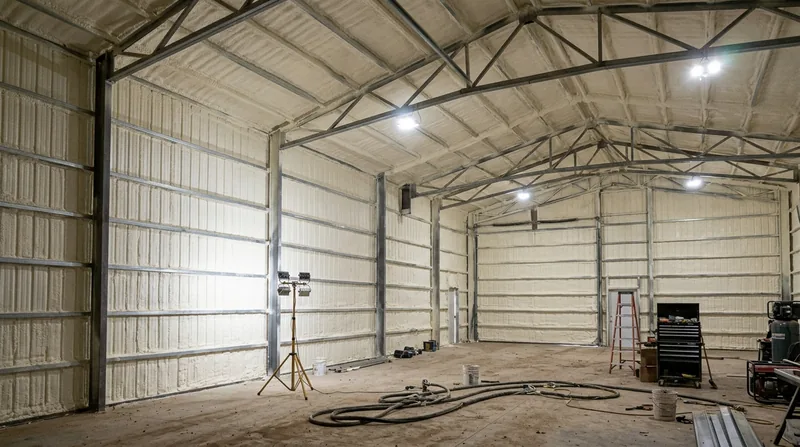




Metal building and barndominium spray foam insulation in Duluth stops the condensation that eats through steel frames across St. Louis, Carlton, and Pine counties every winter. Metal structures sweat when warm indoor air meets the cold metal skin during Duluth's long heating season, and that moisture rusts fasteners, corrodes panels, and rots wood framing from the inside. Spray foam stops the problem at the source by creating a thermal and moisture barrier between the heated interior and the cold metal shell, eliminating the temperature swing that causes condensation to form. Whether you own a pole barn, a metal storage building, or a barndominium in Proctor, Hermantown, or Esko, foam insulation protects your investment and keeps the interior dry year-round. We have been working on metal structures across Greater Duluth since 2012, and we understand the specific failure modes that threaten these buildings in a Lake Superior climate.
Why Metal Building Condensation Control Matters in Duluth
Duluth sits in climate zone 7 on the shore of Lake Superior, where winter temperatures drop well below freezing and the heating season runs from September through May. Metal buildings in this climate experience a steep temperature differential between the heated interior and the exterior metal skin, especially during cold snaps and whenever outdoor humidity is high. That temperature gradient drives moisture from the warm indoor air directly to the cold metal surface, where it condenses into liquid water that pools on purlins, soaks into wood blocking, and accelerates corrosion of fasteners and panel seams.
- Spray foam creates an unbroken thermal barrier that keeps the metal skin warmer, preventing the condensation cycle that destroys metal buildings from the inside.
- Closed cell foam holds moisture out of the assembly and resists water absorption if condensation does occur, protecting the structural integrity of the building.
- A properly installed foam barrier eliminates the need for expensive dehumidification systems or constant ventilation that drives up operating costs.
- Metal buildings insulated with spray foam maintain a drier, more stable interior environment that extends the life of stored equipment, materials, and livestock facilities.
Protecting a metal structure from condensation damage is not optional in Duluth; it is the difference between a building that lasts forty years and one that corrodes through in fifteen.
Local example: A 40-by-80-foot pole barn in Carlton with an open-rafter interior and metal roofing will sweat heavily on the inside of the roof panels during winter whenever the building is heated and the outdoor temperature drops below 20 degrees. Spray foam applied to the underside of the metal roof and to the wall panels stops that condensation entirely, keeping the interior dry and the metal surfaces protected from rust.
For more context on how spray foam controls moisture in metal assemblies, see our closed cell spray foam insulation page, which explains the vapor and thermal properties that make closed cell the standard choice for metal buildings.
How We Insulate Metal Buildings and Barndominiums in Duluth
Every metal building job starts with an on-site assessment to measure the building interior, identify structural details like purlin spacing and wall thickness, and confirm whether the substrate is clean, dry, and ready to receive foam. We check for any moisture, rust, or leaks before we spray, because foam applied over a wet or compromised surface will fail. Once the substrate is confirmed, we set up ventilation to manage cure fumes during application, and we apply foam in controlled passes that build to the specified thickness without exceeding the manufacturer's per-pass limits.
- We measure the building and calculate the square footage and board-foot volume needed to hit your target R-value.
- We inspect the metal skin, fasteners, and framing for moisture, rust, or damage that must be addressed before foam application.
- We set up mechanical ventilation during the spray and cure process to manage fumes and ensure proper curing of the foam.
- We apply foam in multiple passes if needed, maintaining the manufacturer's drum temperature and ratio to ensure consistent density and R-value.
- We confirm the installed thickness and R-value in writing before we leave the site, with a certificate of completion for your records.
The result is a sealed, insulated metal building that holds heat in winter, resists condensation, and requires no ongoing maintenance of the foam system itself.
Local example: A 60-by-100-foot barndominium in Hermantown with a sealed roof deck and living space inside required 4 inches of closed cell foam on the roof structure and 3 inches on the wall cavities to reach R-24 in the roof and R-13 in the walls. We sprayed the roof in two passes and the walls in two passes over two days, with ventilation running continuously during cure. The building now maintains interior temperatures without condensation, and the homeowner has a written record of the thickness and R-value installed.
Learn more about air sealing techniques that complement foam insulation in metal buildings and sealed structures.
Spray Foam Methods for Metal Buildings: Closed Cell vs. Open Cell
| Approach | Description | Best for |
|---|---|---|
| Closed Cell Spray Foam | High-density foam with closed cells that block moisture and air. Typical R-value is 6.0 to 6.5 per inch. Cures to a rigid, waterproof barrier. | Metal buildings, pole barns, and barndominiums where condensation control and moisture resistance are critical. Standard choice for roofs and exterior walls. |
| Open Cell Spray Foam | Lower-density foam with open cells that allow vapor transmission. Typical R-value is 3.5 to 3.6 per inch. Softer and absorbs sound. | Metal buildings where interior noise reduction is a goal and the building is heated and ventilated to control interior humidity. Less common for metal structures in cold climates. |
| Injection Foam into Cavities | Low-pressure closed cell foam injected into existing wall cavities or between metal studs without removing exterior panels. Fills voids and seals air leaks. | Metal building retrofits where the exterior is already in place and interior access is available. Typical for wall cavities between metal studs. |
| Combination Approach | Closed cell on the roof and exterior walls, with injection foam into wall cavities or rim details to seal all air leaks and achieve uniform R-value throughout the building. | New metal buildings and barndominiums where maximum thermal performance and air sealing are required, or retrofits where full coverage is needed. |
Metal Building and Barndominium Spray Foam Cost in Duluth: What to Expect
Spray foam insulation for metal buildings and barndominiums in Duluth starts at approximately $1.75 per square foot for closed cell foam applied to the roof and walls, depending on the thickness needed to reach your target R-value. A 40-by-80-foot pole barn with 4 inches of closed cell foam on a roof deck and 3 inches on the walls will typically fall in the $3,500 to $5,500 range, while a larger structure or one requiring injection foam into cavities may cost more. The final price depends on the building dimensions, the depth of foam required, the complexity of the roof structure, and whether the walls or roof are already partially insulated.
- Building size and square footage of roof and wall surface to be insulated is the primary cost driver, since foam is priced per board foot.
- Thickness and R-value target determine how many passes of foam are needed and how much material is required to meet your heating and condensation goals.
- Access and substrate condition affect setup time and whether the site requires additional preparation before foam can be applied safely.
- Existing insulation or moisture issues may require removal or remediation before foam application, adding to the total project cost.
We recommend getting a free written estimate for your specific building, since metal structures vary widely in size, shape, and condition. Our estimates include the calculated R-value and thickness so you can compare apples to apples with other contractors and understand exactly what you are paying for.
Cost example: A 50-by-100-foot barndominium in Proctor with a sealed roof deck and interior living space might require 4 inches of closed cell foam on the roof (2,500 sq ft) and 3 inches on the north and east walls (1,500 sq ft), totaling roughly 4,000 board feet. At an average of $1.75 per square foot, the total would fall in the $4,200 to $5,600 range before any site-specific factors like access, substrate prep, or existing insulation removal.
For a detailed breakdown of pricing factors and to see a full pricing table, visit our pricing overview page.
Metal Building and Barndominium Spray Foam Near Me: What Duluth Homeowners Should Know When Hiring
When you are looking for a spray foam contractor to insulate a metal building or barndominium near Duluth, Hermantown, or Carlton, verify that the contractor is fully insured and can provide proof of coverage before work begins. Ask for references from previous metal building or barndominium jobs in your area, and check whether the contractor has experience with the specific failure modes that affect metal structures in a Lake Superior climate. Get multiple written estimates that include the R-value, thickness, and square footage so you can compare the scope and quality of work, not just the price.
- Verify that the contractor is fully insured with general liability and workers compensation coverage for spray foam application work.
- Request written estimates that specify the R-value, thickness in inches, and total board feet of foam to be applied, so you know exactly what you are paying for.
- Ask whether the contractor will provide a certificate of completion with the installed thickness and R-value documented, for your records and any future resale or refinance.
- Confirm that the contractor uses mechanical ventilation during spray and cure, and that they maintain a re-entry window of 24 to 48 hours before occupants return to the building.
- Check whether the contractor has handled permit or zoning questions for metal buildings in your city, and whether they can advise on any HOA architectural rules that might apply to exterior work.
The difference between a good spray foam job and a poor one is visible in the estimate itself. A contractor who provides no R-value, no thickness specification, and a price far below market is signaling that the work is not being measured or certified. A contractor who promises immediate re-entry or who cannot explain their ventilation setup during cure is cutting corners that will leave you with odor, off-gassing, and a foam system that does not meet code. Contact us for a free estimate with all the details spelled out, and you will have a clear basis for comparison with any other contractor in the Duluth area.
Metal Building & Barndominium Spray Foam in Duluth: Pricing Guide
| Service | Price | Details |
|---|---|---|
| Closed Cell Spray Foam, Roof Insulation | Starting at $1.75/sq ft | 4 inches typical for metal roofs in zone 7, includes substrate inspection and mechanical ventilation during cure |
| Closed Cell Spray Foam, Wall Insulation | Starting at $1.50/sq ft | 3 inches typical for metal building walls, condensation control is primary goal, cost varies with wall height and access |
| Injection Foam into Existing Cavities | Starting at $2.00/sq ft | Retrofit work into metal stud cavities or rim details without removing panels, more labor-intensive than open spray application |
| Full Metal Building or Barndominium Project | On estimate | Roof plus walls, existing insulation removal, substrate prep, and complex access require on-site measurement and building assessment |
| Travel and Setup | Included | No mileage fee or travel charge within Duluth and surrounding service areas, setup and ventilation included in per-square-foot rate |
| Free Written Estimate | No charge | Includes R-value, thickness, board footage, and scope of work, response within 24 hours at (218) 241-4881 |
Indicative pricing, the exact cost depends on square footage, finish, and site access. Free personalized estimate within 24h at (218) 241-4881.


