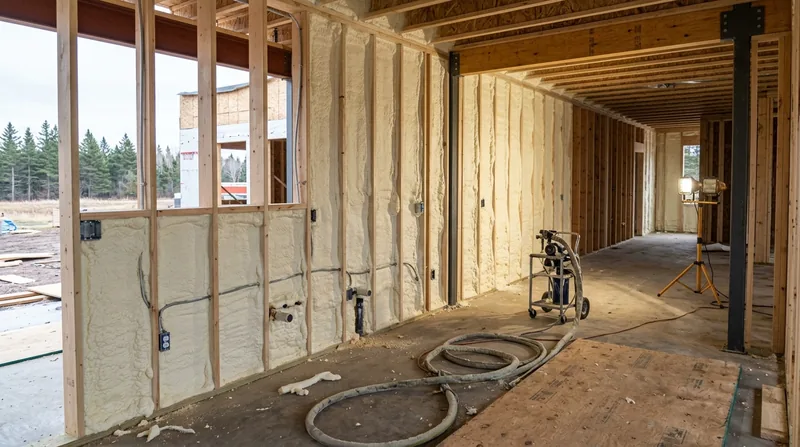




Commercial and new construction spray foam insulation in Duluth requires a continuous air barrier that holds against the stack effect pulling warm interior air upward all winter long. Duluth's new builds toward Hermantown and Proctor, and commercial shells across St. Louis County, sit in IECC climate zone 7 on the shore of Lake Superior, where long heating seasons and lake-effect moisture drive energy performance more than anything else. A tight air barrier around rim joists, top plates, mechanical penetrations, and band joists is the difference between code compliance and a building that bleeds heat and draws in cold, damp exterior air throughout the heating season. We spray foam commercial shells and new construction across the region to meet the energy code that applies at your address, with written estimates specifying R-value and thickness so you know exactly what you are getting. Closed cell spray foam is the standard for new construction because it delivers the air seal, the moisture barrier, and the structural contribution in one pass.
Why Commercial and New Construction Spray Foam Matters in Duluth's Climate
New construction in Duluth and surrounding areas must resist the stack effect, the relentless upward movement of warm, moist indoor air through every gap and penetration in the building envelope during the long heating season. A vented attic in new construction toward Proctor or Hermantown looks tight on the framing, but top plates, rim joists, and mechanical chases still leak unless they are sealed as part of the air barrier system. Spray foam on the roof deck or on interior rim joists creates a continuous seal that fiberglass and blown-in insulation cannot match because those materials are porous and do not stop air movement. Commercial buildings face the same challenge: a steel-frame warehouse or an office shell needs condensation control on cold surfaces and an air barrier to keep the HVAC system from working twice as hard as it should.
- Spray foam seals every gap and penetration in the building envelope in a single pass, stopping the stack effect that pulls warm air upward through rim joists and top plates all winter.
- Closed cell foam delivers R-value, an air barrier, and a vapor retarder in one application, meeting the continuous insulation requirement of modern energy codes.
- New construction spray foam is installed during the framing stage or before drywall, so the air barrier is part of the structural envelope and not an afterthought.
- Commercial shells benefit from spray foam because it controls condensation on metal framing and allows builders to meet code without adding thickness to exterior walls.
Duluth's building officials and energy code requirements are specific to your address and your project timeline, so we defer all permitting and code interpretation to the local authority having jurisdiction.
Key info: New construction projects in Duluth, Hermantown, and Proctor must meet Minnesota's current energy code, which requires a continuous air barrier and R-value that varies by assembly type. Your building department will specify what applies at your address, and we help you meet those requirements with spray foam tailored to your framing and mechanical design.
How We Spray Foam Commercial and New Construction Buildings in Duluth
Our process begins with a site visit and a review of your construction documents so we understand the framing layout, mechanical penetrations, and the energy code that applies to your project. We work with your general contractor or construction manager to schedule the spray foam application at the right stage of construction, typically after framing is complete and before drywall or roof decking closes in the building. We apply closed cell or open cell foam depending on your use case, thickness requirements, and whether you need a vapor retarder as part of the air barrier. All work is performed with mechanical ventilation during application and cure, and we specify a re-entry window so your trades can proceed safely once the foam has set.
- We review your construction plans and energy code requirements so the spray foam is applied at the correct thickness and density to meet R-value and air-sealing specifications.
- We work with your project schedule to spray foam at the framing stage, on roof decks, rim joists, mechanical chases, and any other assembly that needs an air barrier and thermal break.
- We apply foam in controlled passes, monitoring drum temperature and the spray ratio so the material cures properly and delivers the R-value and density specified in your estimate.
- We provide written documentation of the work completed, including board feet applied, thickness achieved, and the date of application so your builder can submit compliance documentation to the building department.
Commercial and new construction spray foam is not a commodity product, and the difference between a proper installation and a quick pass is visible in the curing behavior, the finish quality, and the performance of the building envelope over time.
Example: A new office building shell in Duluth's business district required closed cell spray foam on the roof deck and rim joist to meet the energy code and to control condensation on the steel structure during the heating season. We sprayed 3 inches of closed cell foam, achieving the R-value and air barrier required by the building official, and provided documentation of board feet and application date so the builder could proceed with drywall and final inspection.
Spray Foam Methods for New Construction and Commercial Buildings
| Approach | Description | Best for |
|---|---|---|
| Closed Cell on Roof Deck | High-density spray foam applied directly to the underside of roof sheathing or metal decking, creating a sealed, insulated roof assembly. | New commercial buildings, warehouses, and homes with sealed attics where condensation control and continuous insulation are required. |
| Closed Cell Rim and Band Joist | Spray foam applied to the rim joist and band board at the perimeter of the building, sealing the transition between foundation and floor framing. | New construction where the air barrier must be continuous and condensation on cold metal or masonry must be prevented. |
| Wall Cavity Spray Foam | Low-pressure or medium-pressure spray foam injected into wall cavities between studs during framing or retrofit, filling voids and sealing around wiring and plumbing. | New construction walls where continuous insulation and air sealing are required without adding exterior thickness. |
| Mechanical Chase and Penetration Sealing | Spray foam applied around HVAC ducts, electrical conduit, plumbing runs, and other penetrations to seal the air barrier and prevent thermal bridging. | Commercial buildings and new construction where the air barrier must be continuous and mechanical systems must not compromise the envelope. |
| Metal Building Condensation Control | Closed cell spray foam applied to the underside of metal roof and wall panels to create a thermal break and prevent condensation on cold steel. | Metal warehouses, barndominiums, and agricultural buildings in Duluth's climate where temperature swings and humidity create condensation on uninsulated steel. |
Each approach is tailored to your building type, code requirements, and the specific failure mode you are preventing. We work with your design team and building official to confirm that the spray foam application meets the energy code and the construction schedule.
Commercial and New Construction Spray Foam Cost in Duluth: What to Expect
The cost of spray foam for new construction and commercial buildings depends on the square footage of the building envelope, the thickness and density of foam required by the energy code, the complexity of the framing, and the timing of the application relative to your construction schedule. A small commercial shell or a new home in Duluth may start with a free commercial estimate that specifies the board feet, thickness, and R-value required to meet your code and your design. Large commercial buildings, metal warehouses, or complex multi-story projects will require an on-site evaluation and a detailed estimate that accounts for the building's size, the roof and wall assemblies, and the mechanical systems that must be sealed.
Factors that affect the cost include the total square footage of the building envelope, the R-value and thickness required by the energy code at your address, whether the foam is applied to the roof deck, rim joists, walls, or a combination of assemblies, and the accessibility of the framing during the spray stage. A building with a complex roof geometry, multiple penetrations, or tight coordination with other trades will take longer and may cost more per board foot than a simple rectangular warehouse. Getting multiple estimates from local spray foam contractors is the best way to understand the market rate in Duluth and to identify any scope differences or cost drivers that affect the final price.
We provide a written estimate with R-value and thickness specifications so you know exactly what the cost covers and what performance you will get. Visit our pricing page for typical ranges and factors that move the cost up or down, or call us at (218) 241-4881 for a free estimate on your specific project.
What to Look for When Hiring a Spray Foam Contractor Near Duluth
Choosing the right spray foam contractor for your commercial or new construction project is critical because the quality of the air barrier and the R-value achieved depend entirely on the installer's technique, equipment maintenance, and attention to detail. A good contractor will provide a written estimate that specifies R-value, thickness, and board feet, not just a price per square foot, because those details prove that the estimate is based on your specific building and code requirements. You should verify that any contractor you hire is fully insured and can provide proof of coverage, and you should ask for references from recent commercial or new construction projects in Duluth or nearby areas so you can confirm the quality of their work.
Before you hire, ask about the contractor's process for controlling foam application, including how they manage drum temperature, spray pressure, and ventilation during cure. Ask whether they provide documentation of the work completed, such as board feet applied and the date of application, because your builder will need that information to submit compliance documentation to the building department. Ask about the re-entry window after the foam cures and whether they will coordinate with your other trades to ensure the schedule stays on track. Finally, verify any claims about certifications or manufacturer partnerships by asking for documentation, because the spray foam industry includes both local shops and national franchises, and honest guidance about your specific building is the differentiator.
To get started with a free estimate for your commercial or new construction project, contact us at (218) 241-4881 and we will schedule a site visit to review your plans and provide a detailed quote within 24 hours.
Commercial & New Construction Spray Foam in Duluth: Pricing Guide
| Service | Price | Details |
|---|---|---|
| Free commercial estimate | No charge | Includes site visit, review of construction documents, R-value and thickness specifications, and board feet calculation |
| Closed cell spray foam, roof deck or rim joist | Starting at $1.50 per board foot | Typical new construction projects range from 500 to 3000 board feet depending on building size and code requirements |
| Wall cavity or mechanical chase spray foam | Starting at $1.25 per board foot | Smaller volumes and simpler geometry than roof or rim work, but requires coordination with framing stage and other trades |
| Metal building or warehouse condensation control | Starting at $1.50 per board foot | Closed cell foam on roof and wall panels requires careful planning and application to prevent thermal bridging and condensation |
| Travel and mobilization | Included | No separate mileage or travel fee for projects in Duluth, Hermantown, Proctor, and surrounding service areas |
| Estimate response | Free | Contact us at (218) 241-4881 and we will schedule a site visit and provide a written estimate within 24 hours |
Indicative pricing, the exact cost depends on square footage, finish, and site access. Free personalized estimate within 24h at (218) 241-4881.


