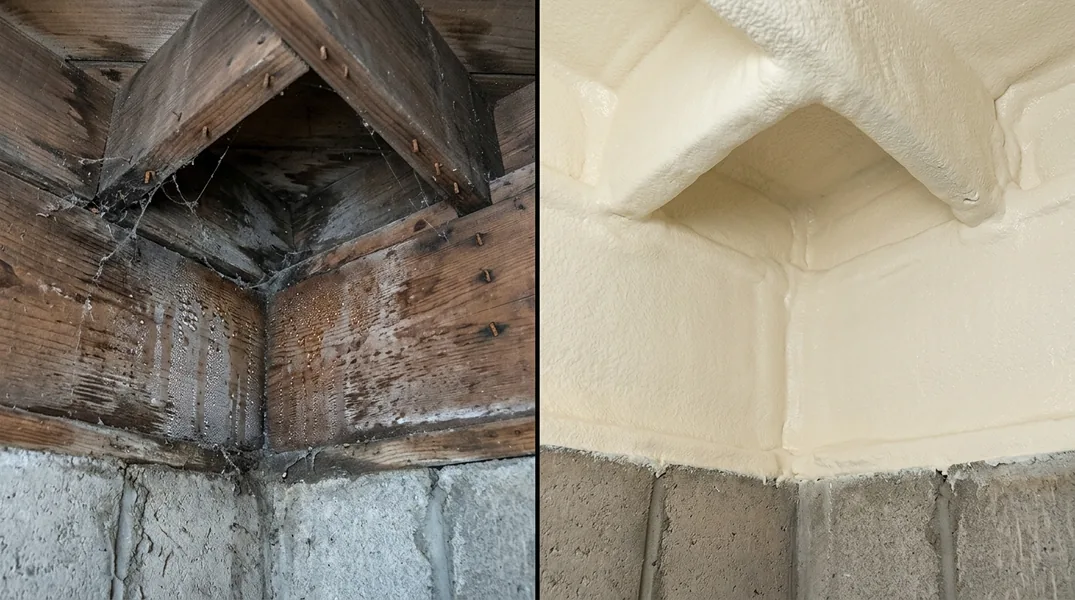
The Charm and Challenge of Early 1900s Lakeside-Lester Park Homes
The Lakeside-Lester Park neighborhood in Duluth is known for its stunning early 1900s architecture, mature trees, and proximity to the waterfront. These charming homes, with their solid construction and period details, represent a significant part of our region's heritage. However, homeowners in this area often discover that their beautiful vintage properties come with a hidden challenge: inadequate insulation and, more specifically, a persistent problem with rim joists that allow conditioned air to escape and cold drafts to infiltrate.
If you own one of these classic homes, you've likely noticed higher-than-expected heating bills, cold spots in upper floors, or drafts near the foundation walls. The culprit is often the rim joist, which is the band of framing that sits on top of the foundation wall and connects the first floor to the basement. In homes built during the early 1900s, this area was rarely insulated properly, and standard solutions like blown-in insulation often fall short. This is where modern spray foam technology offers a game-changing solution.
Understanding the Rim Joist Problem in Older Duluth Homes
The rim joist is one of the most commonly overlooked areas in attic and foundation insulation. This structural component runs around the perimeter of your home where the first floor sits on the foundation, and it's directly connected to your basement or crawl space. In early 1900s construction, builders focused on structural integrity but gave little thought to thermal performance. As a result, most older homes in Duluth have rim joists that are either completely uninsulated or filled with deteriorated materials that no longer provide any thermal value.
The problem is compounded by the rim joist's unique geometry. Unlike a flat attic floor where you can simply pour blown-in insulation, the rim joist is a three-dimensional space with multiple cavities, gaps, and hard-to-reach corners. Blown-in insulation tends to settle unevenly, leaving air pockets and voids. Additionally, the rim joist is often in contact with exterior walls and is exposed to temperature fluctuations, making it a prime location for air leakage. Many homeowners report that even after attempting to insulate this area with traditional methods, they still experience drafts and energy loss. This is precisely why Attic Spray Foam Insulation has become the preferred solution for addressing this persistent issue.
Spray Foam vs Blown-In Insulation: Why Spray Foam Wins for Rim Joists
When comparing spray foam vs blown-in insulation for the rim joist problem, the differences become immediately apparent. Blown-in insulation, whether cellulose or fiberglass, is loose material that is pneumatically applied into cavities. While this approach works reasonably well for open attic spaces, it has significant limitations when it comes to rim joists. Blown-in materials cannot effectively fill irregular shapes, cannot seal air leaks, and tend to settle over time, leaving gaps that compromise performance. In the context of spray foam vs cellulose or spray foam vs fiberglass, spray foam delivers superior air sealing and maintains its R-value over decades without settling.
Closed Cell Spray Foam Insulation is specifically engineered to address rim joist challenges. When applied, it expands to fill every cavity, crack, and gap, creating a continuous thermal and air barrier. Unlike blown-in materials, spray foam adheres to surfaces and hardens, preventing any settling or shifting. It also provides structural reinforcement to the rim joist itself. For homeowners debating the best insulation for attic and foundation areas, spray foam's superior air sealing properties and long-term performance make it the clear winner, especially in older homes where air leakage is a significant energy drain.
Spray Foam vs Fiberglass and Other Traditional Methods
Fiberglass batts and blankets are perhaps the most common insulation method homeowners encounter, but they are poorly suited for rim joists. Fiberglass requires a cavity of consistent width to perform effectively, and it must be carefully installed to avoid compression, which reduces its R-value. In a rim joist, where cavities are often irregular and access is limited, fiberglass installation is difficult and the results are often substandard. Additionally, fiberglass does not seal air leaks; it only resists heat transfer through conduction. This means that even if you install fiberglass in a rim joist, air can still move around it, carrying heat out of your home during winter.
When you compare spray foam vs fiberglass for the rim joist problem, spray foam's air-sealing capability becomes the decisive factor. Spray foam creates an airtight seal that stops both conduction and convection losses. It also resists moisture infiltration better than fiberglass, which can absorb water and lose its insulating properties. For homeowners in older neighborhoods like Lakeside-Lester Park who are serious about improving energy efficiency and comfort, the investment in spray foam delivers results that fiberglass simply cannot match. The longevity of spray foam, which can last 80+ years without degradation, also makes it a more economical choice over the life of your home.
Why Open Cell Spray Foam Insulation and Closed Cell Options Differ for Your Rim Joist
When considering spray foam solutions, it's important to understand the difference between open cell and closed cell formulations. Closed cell spray foam has a higher R-value per inch (typically R-6 to R-7 per inch) and provides superior air sealing and moisture resistance. This makes it the ideal choice for rim joists, especially in older homes where moisture and air infiltration are concerns. Closed cell foam also provides structural benefits and can help prevent water intrusion from foundation cracks or exterior water exposure. Open cell foam, while less expensive, has a lower R-value (approximately R-3.6 per inch) and is more permeable to moisture, making it less suitable for rim joists in contact with exterior walls and foundation areas.
For homeowners in Duluth, where winters are harsh and humidity can be a concern, closed cell spray foam is typically the recommended choice for rim joist insulation. It provides the combination of high R-value, air sealing, and moisture control that these challenging spaces require. Open cell foam may be appropriate for interior walls or attic spaces where moisture management is less critical, but the rim joist is best served by closed cell technology. Understanding these distinctions helps homeowners make informed decisions about which spray foam solution will deliver the best long-term performance and energy savings for their specific situation.
Attic Spray Foam Insulation Cost in Duluth: What to Budget
Homeowners considering spray foam solutions often ask about pricing and what they should expect to invest. The cost of spray foam insulation varies based on several factors, including the square footage of the rim joist area, the thickness of foam required to achieve desired R-values, accessibility, and whether additional preparation work is needed. In general, closed cell spray foam costs more per square foot than blown-in insulation or fiberglass batts, but the superior performance and longevity justify the investment. When you factor in energy savings over 20 to 30 years, the actual cost per year of operation becomes quite competitive.
For a typical early 1900s home in Lakeside-Lester Park with a rim joist area of 800 to 1,200 linear feet, homeowners should budget for a meaningful investment that will pay dividends through reduced heating costs and improved comfort. The exact cost depends on your specific situation, which is why getting a detailed assessment is essential. Duluth Spray Foam Insulation offers free estimates that account for your home's unique characteristics, existing insulation, and energy goals. By investing in professional spray foam application now, you'll enjoy lower utility bills, fewer drafts, and better temperature control for decades to come. Call us today at (218) 241-4881 to discuss your rim joist insulation needs and receive a customized quote.
Attic Spray Foam Insulation Near Me: When to Call a Professional
If you own a home in the Lakeside-Lester Park area or anywhere in Duluth, and you're experiencing energy efficiency issues, it's time to consider professional spray foam insulation. The rim joist problem is not something homeowners should attempt to DIY with blown-in insulation or fiberglass. Spray foam application requires specialized equipment, training, and expertise to ensure proper application, safety, and performance. Professional installers understand how to properly prepare the rim joist area, apply foam to the correct thickness, and ensure complete coverage of all gaps and cavities.
Duluth Spray Foam Insulation has been serving the Duluth area with professional spray foam solutions for homes of all ages and styles. Our team specializes in addressing the unique challenges of older homes, including rim joist insulation, attic insulation, and Wall & Injection Foam Insulation for existing walls. We use only high-quality closed cell foam products and follow industry best practices to ensure your home receives the best possible insulation performance. If you're ready to stop wasting energy and start enjoying a more comfortable, efficient home, contact us at (218) 241-4881 or visit our website to schedule your free estimate today.
Looking for a professional spray foam insulation contractor in Duluth? Duluth Spray Foam Insulation responds fast for all your spray foam insulation needs.
Get a Free Quote